Disclaimer: This analysis is intended for research, benchmarking, and informational use only. It does not constitute legal advice. Patent applications must be reviewed by qualified patent counsel to ensure compliance with jurisdiction-specific standards.
1. Introduction
The landscape of intellectual property (IP) creation is undergoing a profound shift. Drafting patent applications, traditionally a manual, expertise, intensive, and costly process, requires strict adherence to USPTO conventions, clear articulation of novelty, and technical completeness. As innovation accelerates, organizations increasingly seek tools that shorten the drafting cycle without compromising quality or legal defensibility.
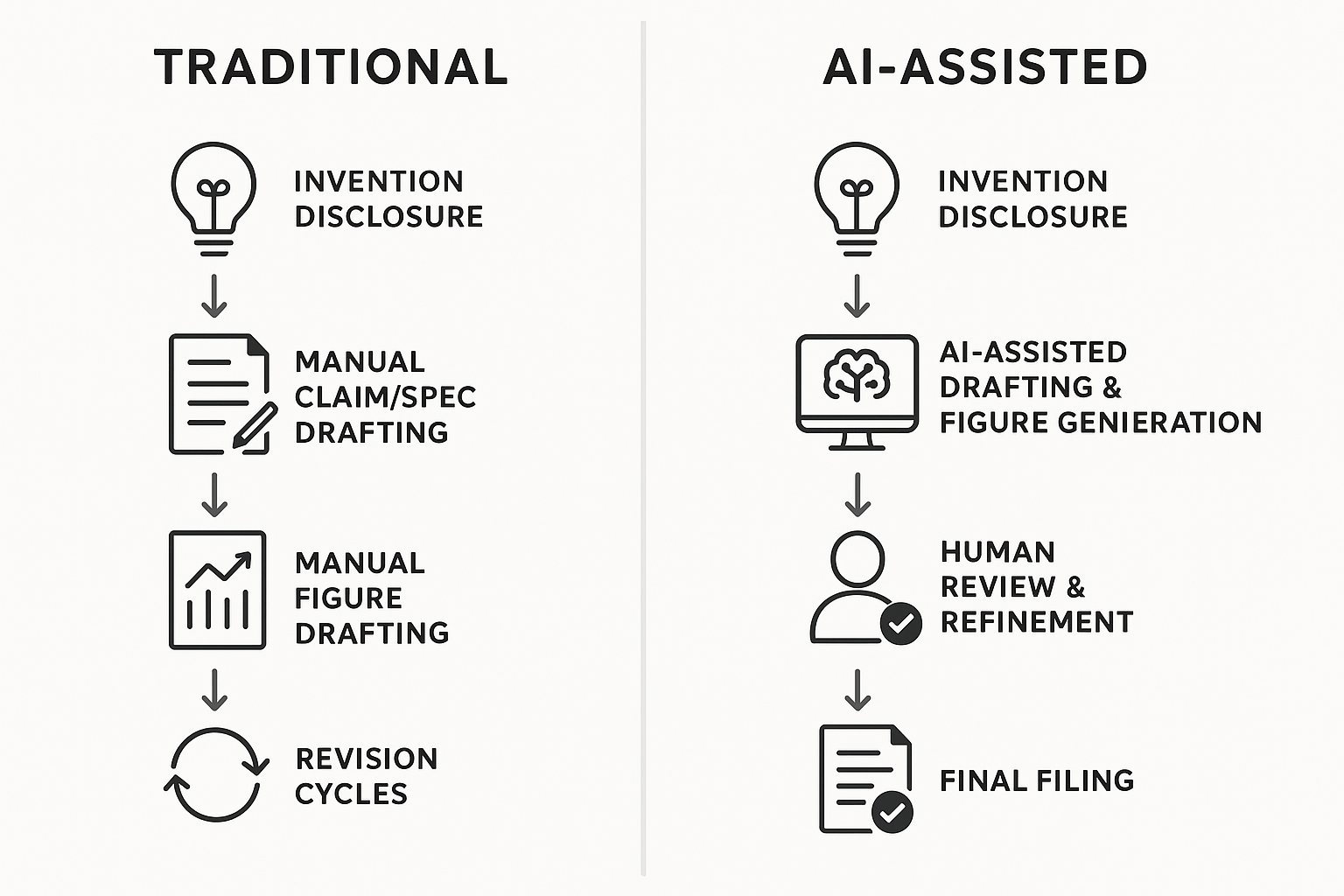
Figure 1. Demonstration of traditional patent workflow and AI assisted patent workflow
Large language models (LLMs) have brought new possibilities to early-stage patent drafting. However, research consistently shows that general-purpose LLMs struggle with structural and legal requirements unique to patent documents. The PatentEval [1] study highlights errors in structure, dependency logic, and technical consistency across model outputs. Similarly, the PatentScore [2] study finds that traditional NLP metrics have low or even negative correlation with expert judgments of patent quality, because patent claims depend on legal structure rather than pure linguistic similarity.
These limitations underscore a broader challenge: while LLMs excel at natural language fluency,patent drafting demands structured reasoning, constraint adherence, and legal precision—not just linguistic generation.
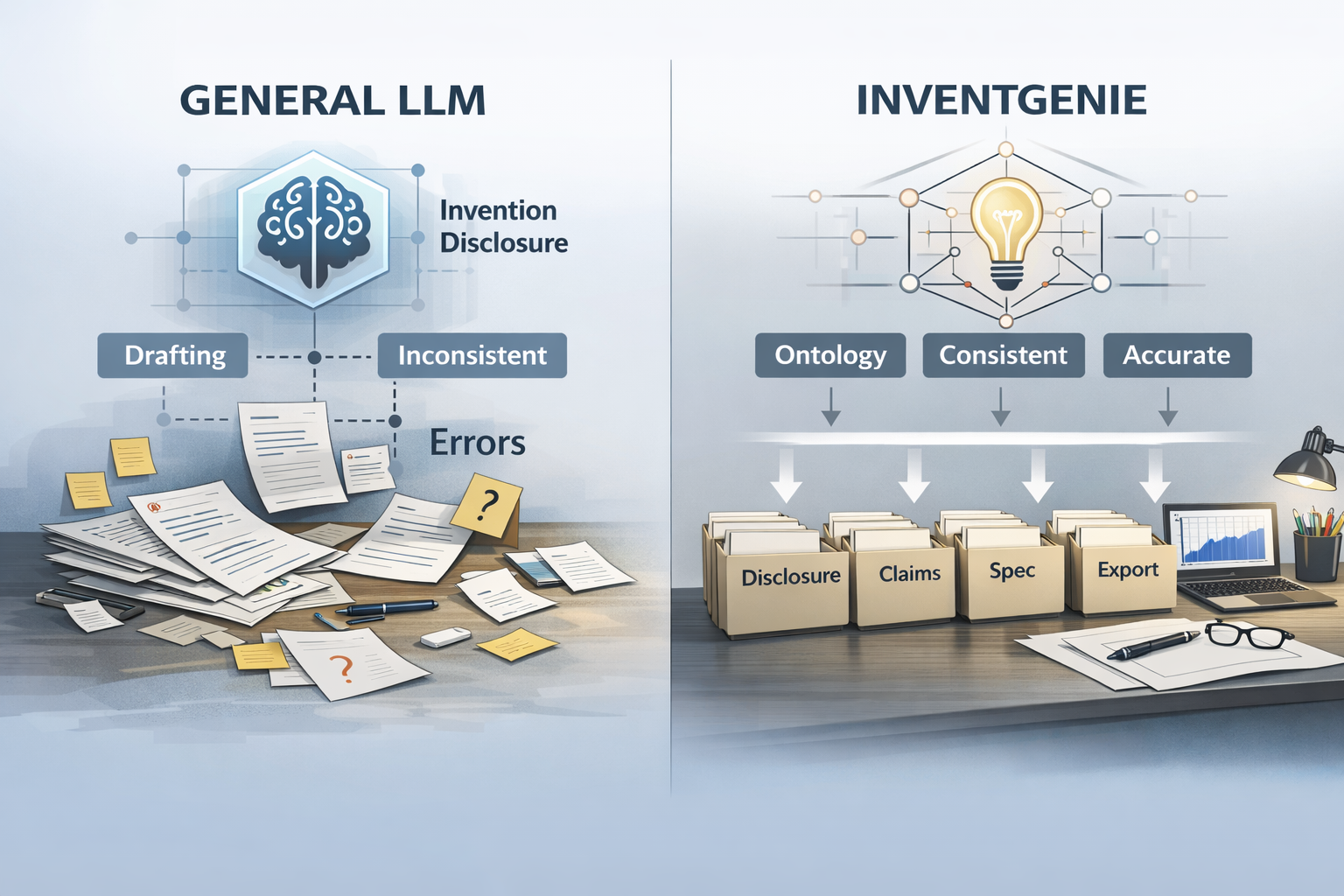
This analysis evaluates InventGenie—an AI system specifically engineered for patent drafting, against general-purpose LLMs such as ChatGPT, Gemini, and Claude. A key differentiator explored in detail is InventGenie's knowledge-graph–driven claim generation, which anchors the drafting process in structured, machine-interpretable representations of inventions.
2. The Bottleneck in Traditional Patent Drafting
Drafting patent applications requires:
- Deep technical understanding
- Rigid compliance with MPEP §608 and claim-formatting rules
- Precise terminology and structural consistency
- Clear support under §112(a) (written description + enablement)
- Legally defensible claim boundaries
These requirements create significant bottlenecks for inventors, startups, universities, and corporations. Even small structural defects—missing antecedent basis, incorrect claim dependencies, contradictory terms, can invalidate claims or lead to costly prosecution cycles.
Research documented in PatentEval [1] and PatentScore [2] confirms that generic LLMs frequently produce such defects, despite their fluency. Problems include:
- Missing or incorrect antecedent basis
- Inconsistent terminology
- Illogical claim hierarchies
- Contradictory embodiments
- Redundant or trivially distinct claims
These issues make general LLM outputs unsuitable for direct use in patent applications without substantial human reconstruction.
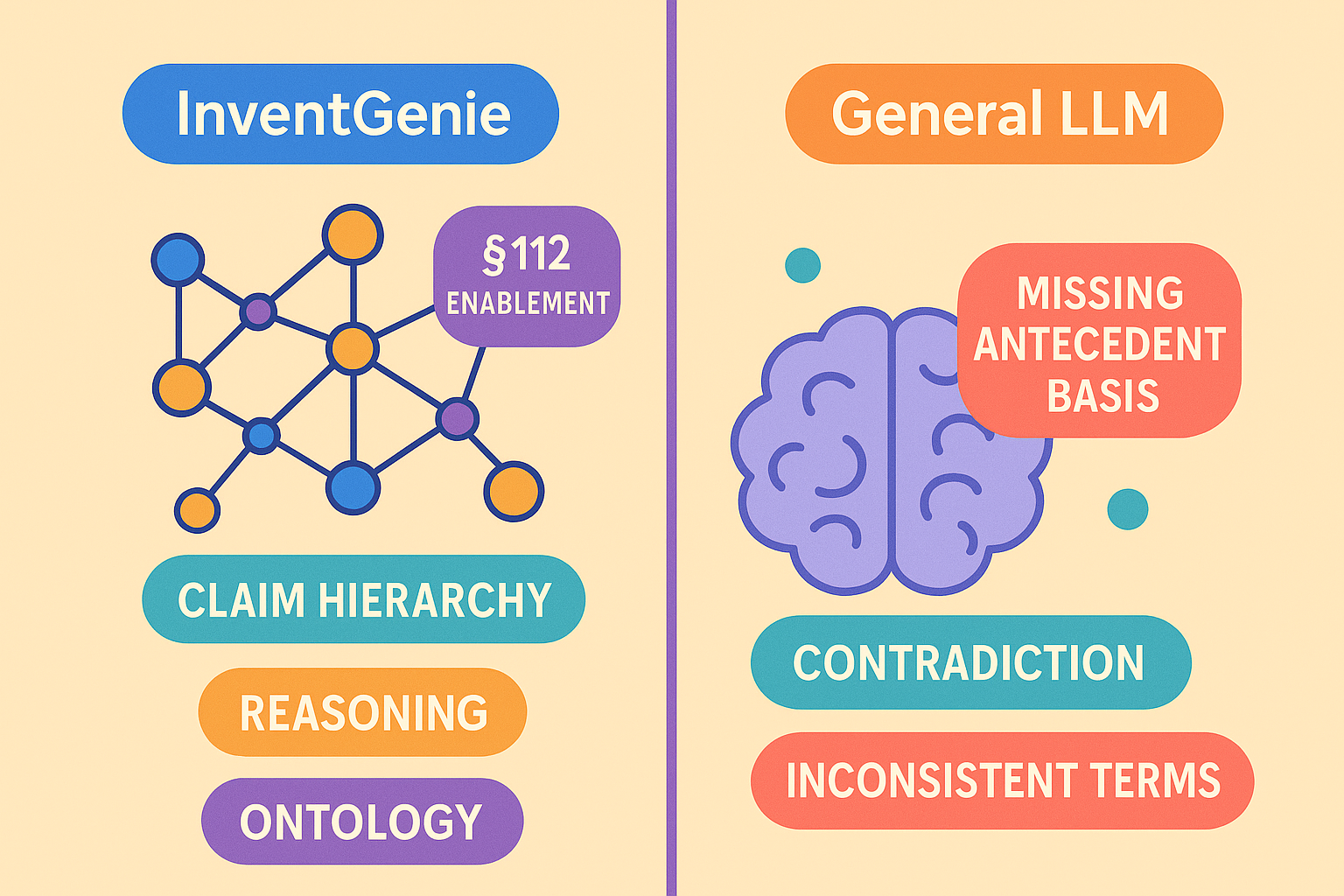
Figure 2. Left-side: Depiction of InventGenie Knowledge Graph. Right Side: Defects of General LLM for patent generation
3. InventGenie: A Domain-Specialized Patent Drafting Engine
InventGenie introduces a new paradigm for structured patent drafting by combining large-model reasoning with a patent-specific ontology (knowledge graph).
The system is designed not merely to generate fluent text, but to produce legally structured, technically coherent, prosecution-ready drafts.
Key Advantages
Speed to Draft
Converts invention disclosures into structured drafts in minutes—compressing weeks of manual effort.
Cost Efficiency
Automates the most labor-intensive aspects of drafting, allowing attorneys to focus on strategic claim shaping and prosecution.
Scalability
Supports high-volume invention pipelines without increasing headcount, enabling universities and enterprises to protect more IP assets.
Consistency & Compliance
Ensures alignment with USPTO structure and MPEP expectations, improving clarity and reducing examiner objections.
Innovation Enhancement
Suggests alternative embodiments and articulates advantages, strengthening novelty and non-obviousness arguments.
4. A Transformative Feature: Knowledge-Graph–Driven Claim Generation
A defining capability of InventGenie—and the most significant differentiator from general-purpose LLMs—is its knowledge graph used to generate patent claims.
This approach brings structural rigor to an area where generic LLMs are weakest.
4.1 What the Knowledge Graph Represents
InventGenie converts the invention disclosure into a formal graph representing:
- Components
- Subsystems
- Functional relationships
- Data flows
- Alternative embodiments
- Dependencies and constraints
This creates a machine-interpretable model of the invention, which becomes the backbone of the patent drafting process.
4.2 How It Enhances Claim Generation
Every claim element corresponds to a node or relationship in the graph, ensuring:
- Correct antecedent basis
- Proper dependency hierarchy
- Terminology consistency
- Logical progression from broad to narrow claims
- Embodiments that reflect real technical variations
This eliminates the most common LLM errors documented in PatentEval [1] and PatentScore [2].
4.3 Benefits Over General-Purpose LLMs
General LLM Failure Modes
Generic LLMs commonly produce:
- ❌ Missing antecedent basis
- ❌ Nonexistent or contradictory claim elements
- ❌ Overly broad or overly narrow claims
- ❌ Redundant dependent claims
- ❌ Unstable terminology across sections
- ❌ Incomplete support for §112(a) enablement
These issues arise because generic LLMs rely on probabilistic text prediction, not structured invention models.
InventGenie's Knowledge Graph Avoids These Errors
Because claims are generated from a structured ontology:
- ✔ Dependency logic is correct
- ✔ Elements align with the technical description
- ✔ Terms do not drift
- ✔ Claim families (system, device, method) remain cross-consistent
This allows InventGenie to produce prosecution-ready claim sets, while general LLMs require substantial manual rewriting.
5. Comparative Evaluation of Drafting Systems
Testing was conducted across multiple models—ChatGPT 5.1, Gemini 3 Pro, Claude Sonnet 3.5, and InventGenie—evaluating:
- USPTO formatting compliance
- Narrative clarity
- Technical completeness
- Legal sufficiency under §112
- Overall usability in a full patent application
These categories mirror structural and legal dimensions in PatentScore [2], where such dimensions account for nearly 90% of expert scoring weight (semantic similarity alone correlates poorly with quality).
5.1 InventGenie vs ChatGPT vs Claude vs Gemini
| Category | InventGenie | ChatGPT 5.1 Auto | Gemini Pro 3 | Claude Sonnet 4.5 |
|---|---|---|---|---|
| Formatting | USPTO-style hierarchy, sectioned, prosecution-ready | Clean and readable but not inherently USPTO-structured | Clear formatting but often informal and non-patent-like | Minimalist, clean, not automatically patent-formatted |
| Narrative Clarity / Depth | Deep technical context, domain-specific decomposition | Simple, concise, easy to read | Very readable, natural explanations | Clear, high-level conceptual reasoning |
| §112 Enablement / Viability | Strong enablement using ontology-like technical scaffolding; supports broad + narrow claims | Adequate for narrow/simple inventions; may miss technical scaffolding | Moderate enablement; depth varies with prompt | Needs expansion; good logic but lacks claim-grade detail |
| Draft Usability | Submission-quality; aligns with USPTO expectations; claim-ready | Great for summaries, overviews, or rewriting | Good for ideation and early drafting | Useful for conceptual framing, not finished claims |
| Ideal Use Case | Complex systems, broad architectures, prosecutable drafts | Summaries, rewriting, quick drafts | Early brainstorming, examiner-friendly overviews | Narrative clarity, conceptual structuring |
Table 1. Table of Comparative test results between InventGenie, ChatGPT 5.1 Auto, Gemini Pro 3, Claude Sonnet 4.5
6. Results Summary
InventGenie
- Strongest compliance with USPTO structure
- Superior technical and legal rigor
- Knowledge-graph backbone eliminates structural claim errors
- Provides complete support for §112 enablement
- Produces prosecution-ready drafts
ChatGPT
- Good formatting discipline
- Outputs too generalized for claims or detailed descriptions
Gemini
- Very readable
- Weak technical depth beyond high-level explanations
Claude
- Excellent clarity
- Insufficient specificity for enforceable claims
7. Strategic Implications for IP Teams
PatentScore findings show that structural and legal correctness are the strongest predictors of claim quality, far more than textual fluency or semantic similarity.
Generic LLMs are not optimized for:
- Structured legal reasoning
- Claim hierarchy formation
- Terminological consistency
- Cross-section alignment
InventGenie directly addresses these gaps via:
- Fine tuning of original ideas
- Ontology-driven / Knowledge-graph claim generation
- Automated support for enablement and prior-art positioning
For organizations seeking to scale patent drafting, InventGenie is suitable as a primary drafting engine, while general LLMs should be used only for supporting tasks such as brainstorming or summarization.
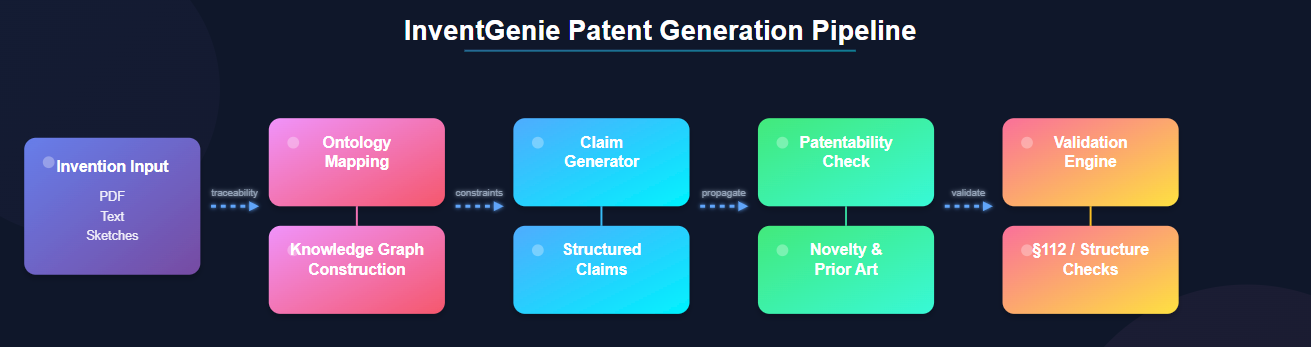
Figure 3. Overview of InventGenie patent generation workflow
8. Conclusion
AI-driven patent drafting has evolved from experimental curiosity to practical necessity. Yet the gap between natural-language generation and legal-technical drafting remains significant. Research shows that general-purpose LLMs, despite their fluency, are prone to structural, logical, and legal errors that undermine claim validity.
InventGenie overcomes these limitations through a patent-specific ontology and knowledge-graph–based claim generation, enabling the production of structured, consistent, prosecution-ready drafts. Unlike general LLMs, InventGenie integrates technical reasoning, legal formality, and structured models of inventions, making it uniquely suitable for real-world patent workflows.
As organizations scale their innovation pipelines, InventGenie provides the precision, consistency, and legal rigor needed to convert ideas into enforceable intellectual property efficiently and reliably.
References
- Y. Zuo, K. Gerdes, É. Clergerie, and B. Sagot, "PatentEval: Understanding Errors in Patent Generation," in Proc. 2024 Conf. of the North American Chapter of the Association for Computational Linguistics: Human Language Technologies (NAACL-HLT), vol. 1: Long Papers, Mexico City, Mexico, Jun. 2024, pp. 2687–2710. [Online]. Available: https://aclanthology.org/2024.naacl-long.147/
- Y. Yoo, Q. Xu, and L. Cao, "PatentScore: Multi-dimensional Evaluation of LLM-Generated Patent Claims," arXiv preprint arXiv:2505.19345, May 2025. [Online]. Available: https://arxiv.org/abs/2505.19345