USPTO's 2024 AI Guidance: What Founders Need to Know About Patenting AI-Assisted Inventions (Part 1)
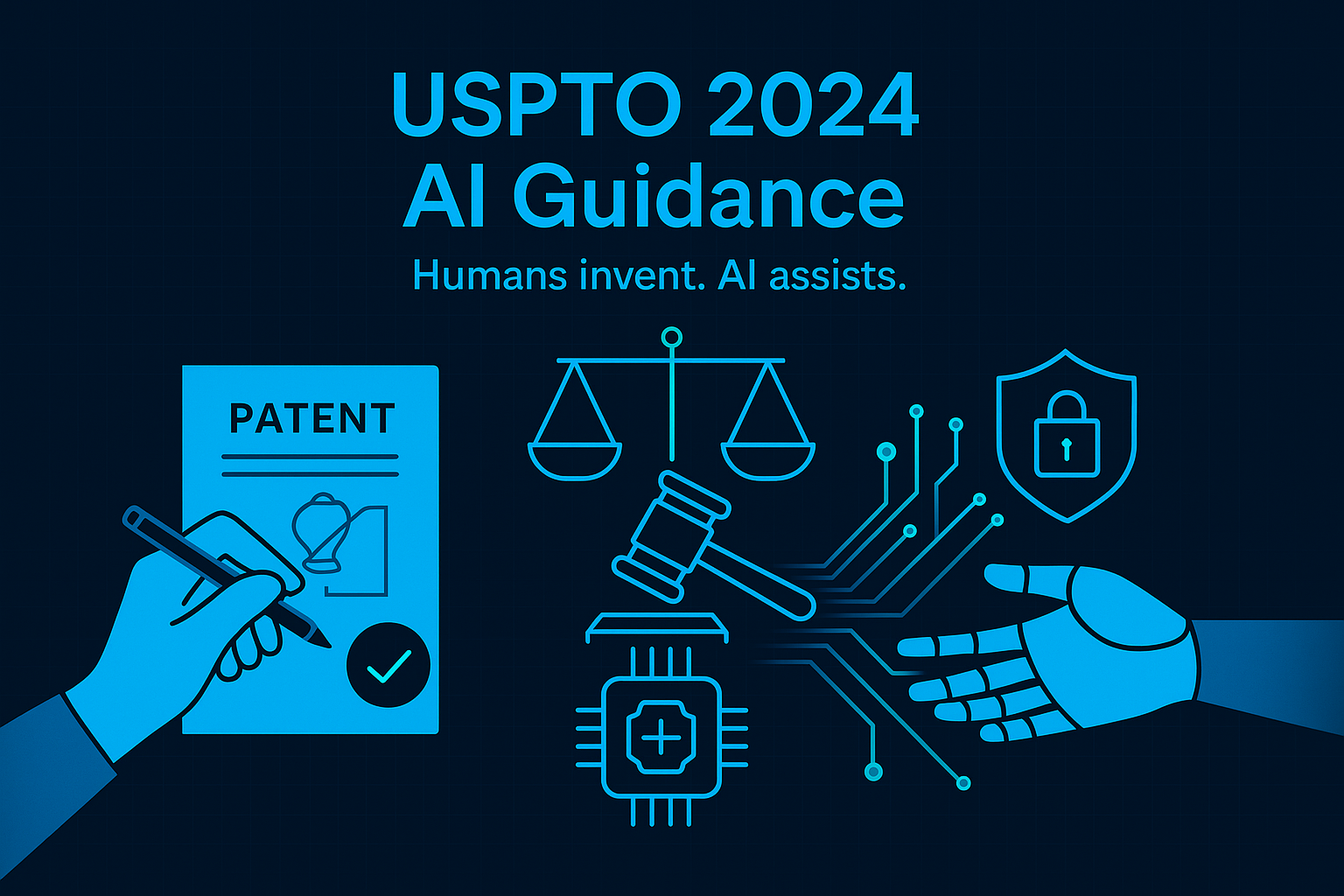
Artificial intelligence is now baked into how many teams invent: from drug discovery to sensors to fintech. But once AI is inside your product, it also lands you in the middle of patent law, inventorship rules, and shifting USPTO expectations. If you are a founder or CEO, you cannot just think "cool AI feature" – you also have to think "can we protect this, and will it hold up later?"
The latest 2024 guidance from the U.S. Patent and Trademark Office (USPTO) is a clear signal. You can patent AI-assisted inventions, but only if two things are true:
- A human (or team of humans) made a significant inventive contribution, and
- Your claims show a real technical improvement, not just "we used AI to do X."
Part 1 focuses on the two early gates you must clear: patent eligibility under Section 101 and human inventorship. Part 2 will move into claim strategy, portfolio planning, business-method traps, and fundraising implications.
Why this matters for founders
AI touches almost every sector now: health, materials, logistics, software, finance, and more. For many startups, the AI layer is what sets them apart.
The USPTO's message is blunt:
- AI-assisted inventions can be patentable.
- But AI cannot be listed as an inventor.
- Patent examiners will probe what the human inventors actually did.
- Claims that read like "we used machine learning to do business thing X" are at high risk, especially under the abstract idea doctrine.
If you do not align your R&D and IP processes with this guidance, you risk: no patent at all, a patent that is easy to attack, or a weaker valuation at funding or exit.
Section 1: The Patent Eligibility Landscape – Why §101 Still Haunts AI Inventions
A lot of founders jump straight to "Are we novel?" or "Is this obvious?" But before that, your application has to clear 35 U.S.C. § 101: is this the type of thing that can be patented at all?
For AI-assisted inventions, this is where many claims die.
Key hurdles under §101
Section 101 says patents are available for:
- Processes
- Machines
- Manufactures
- Compositions of matter
Over time, courts added "judicial exceptions" that are not patentable on their own:
- Laws of nature
- Natural phenomena
- Abstract ideas
AI often triggers the abstract idea problem, because it is easy for a claim to look like: pure data manipulation, mathematical concepts, or mental steps that could in theory be done by a human.
The USPTO uses the Alice/Mayo style test for this, and its 2024 AI guidance explains how examiners should apply it to AI-related claims.
The Step 2A test, in plain terms
Step 2A has two prongs:
Prong One – Is there a judicial exception?
Examiners ask: does the claim recite an abstract idea (like math, mental steps, or basic data handling)?
Many AI claims do, because they describe training models, scoring, predicting, ranking, etc.
Prong Two – Is there a practical application or technical improvement?
If yes, the question becomes: have you integrated that abstract idea into a practical application or shown an improvement in technology or a computer system?
Example: not just "AI predicts failure," but "AI in an embedded sensor system that cuts latency by 30% and reduces false alarms in real-time monitoring."
The 2024 examples (47–49) show both sides: what examiners see as too abstract, and what crosses the line into "technical improvement."
What this means for how you describe your system
To clear §101 for AI inventions, you need more than "we use a model":
- Spell out the system architecture: devices, servers, edge nodes, sensors, networks.
- Explain data flows: where data comes from, how it is processed, at what stage, and how it is stored or acted upon.
- Include training and inference details where they matter: dynamic updates, edge retraining, handling of drift, etc.
- Tie the AI to concrete system outcomes: lower latency, less power use, higher throughput, better accuracy under specific constraints.
A weak claim:
"A method for using AI to predict user behavior."
A stronger claim concept:
"A computer-implemented method where an AI model deployed on edge devices analyzes sensor streams in real time to reduce network usage and cut alert latency by at least X% compared to a static baseline."
The technology story has to be in the claim, not just the slide deck.
A blunt truth for founders
If you treat your AI like "software + buzz," you will get classic software rejections. If you frame it as a technical upgrade to a system – with concrete improvements and real-world constraints – you have a fighting chance. That shift is less about legal magic and more about how clearly your team can describe what is happening under the hood.
Section 2: The 2024 Guidance Updates – What Actually Changed
The USPTO's 2024 updates take AI from a side note to a core focus. They sit on top of the earlier 2019 Patent Eligibility Guidance, but they speak directly to modern AI use.
July 17, 2024 – Subject Matter Eligibility update
This update was issued under the Biden Administration's Executive Order 14110 on "Safe, Secure, and Trustworthy Development and Use of Artificial Intelligence."
Key points:
- Effective July 17, 2024.
- Introduces Examples 47–49 focused on AI inventions.
- Explains how to apply Step 2A (and Step 2B) to AI patents.
- Stresses technical improvement and practical application when AI appears in the claim.
- Reminds everyone that this is guidance, not formal rulemaking, but examiners are expected to follow it.
September 10, 2024 – AI Guidance for business methods and AI-assisted inventorship
A second update in September 2024 focuses on:
- AI in business-method contexts (fintech, advertising, logistics, etc.).
- The need for significant human contribution to AI-assisted inventions.
- Clear limits: only natural persons can be listed as inventors. AI cannot.
It also digs deeper into: when a claim does not recite an abstract idea at all, when it does, and what kind of claimed improvement is needed to save it.
How this differs from pre-2024 guidance
Before 2024:
- AI was treated as a subset of software.
- The 2019 guidance gave broad rules for computer-implemented inventions, but did not focus heavily on AI.
After the 2024 updates:
- AI is treated as a central topic.
- Founders and counsel have clearer signals on what examiners will look for in AI claims: clear human inventors, concrete technical improvements, real implementation details, not generic "use AI" language.
How to use the guidance as a founder
Treat the 2024 guidance as a design spec for your patent story:
- Study the AI examples (47–49).
- Ask: "Can we frame our system the way the eligible examples do?"
- If the answer is no, that is a warning to either adjust your claim structure, or rework how you describe the invention in the spec.
In other words, do not write your patent first and check the guidance later. Start with the guidance and design your patent story around it.
Section 3: Inventorship & AI-Assisted Inventions – Who Actually Counts as an Inventor?
Once you clear eligibility, you hit the next big gate: inventorship.
The law here is simple but strict:
- Only humans can be inventors.
- AI cannot be named as an inventor or joint inventor.
- AI-assisted inventions are inventions where human inventors used one or more AI tools as part of the work.
This is backed by the Federal Circuit's decision in Thaler v. Vidal (2022), which confirmed that an AI system cannot be listed as an inventor.
What "significant contribution" means in AI-heavy work
The hard part is drawing the line between "just using a tool" and "making an inventive contribution."
The USPTO guidance builds on the Pannu factors, which say that an inventor must:
- Contribute in a significant way to the conception or reduction to practice.
- Do more than something minor compared to the full invention.
- Be involved in the conception, not just carry out the orders of someone else.
In an AI setting, that means:
Simply pressing "run" on an AI tool is not enough.
The human must steer and shape the inventive outcome.
Examples of significant human contribution:
- Defining the problem the AI will address.
- Selecting, training, or tuning the model and dataset in non-obvious ways.
- Interpreting AI outputs, rejecting bad ones, and combining results creatively.
- Integrating AI outputs into a working system with technical constraints, not just copying what the model gave.
- Making choices that are not routine, and that affect the final claimed features.
The guidance also stresses the duty of disclosure: Applicants must disclose material information about how AI was used. That includes information that might show an inventor did not make a significant contribution.
A simple "inventorship audit" matrix for founders
You can treat inventorship like an internal audit across these stages:
| Stage of invention | Human contribution question | Evidence you should keep |
|---|---|---|
| Problem definition | Who framed the technical problem and constraints? | Notes, specs, meeting minutes |
| Model selection / training | Who chose architecture, data, hyperparameters, or pipelines? | Training logs, Git history, design docs |
| Output review & selection | Who chose which AI outputs to keep, change, or combine? | Review notes, test reports, decision logs |
| System integration | Who designed the system that uses the AI output in practice? | Architecture diagrams, prototypes, claim drafts |
| Ownership & assignment | Are all inventors identified, and are rights assigned to company? | Employment and assignment agreements |
If, under scrutiny, it looks like an AI tool did all the "thinking," your patent can be attacked on inventorship grounds.
What founders should do right now
- Track contributions: Start keeping inventor logs for AI-heavy projects.
- Align with counsel: Work with your patent lawyer to map contributions to the Pannu factors.
- Write human contributions into the spec: Include sentences like "Inventor A defined X, configured Y, and selected Z outputs from the AI system."
- Avoid vague AI language: Phrases like "AI-generated insights" without human detail are red flags.
Weak inventorship does not just risk validity – it also weakens your story to investors and acquirers. If you cannot clearly say who invented what, your IP is easier to discount.
How Part 1 and Part 2 fit together
In Part 1, we covered:
- Why AI patents matter for founders right now
- How Section 101 and the abstract idea doctrine hit AI inventions
- What changed in the USPTO's 2024 AI guidance
- Why human inventorship and documentation are non-negotiable
In Part 2, we will go deeper into:
- Claim-drafting tactics for AI patents
- Building a full AI IP portfolio (not just one patent)
- How to handle AI + business methods
- Future trends, risk management, and how this all plays into fundraising and exits
You can publish Part 1 and Part 2 as a clear series, or as two related stand-alone posts.
Read Part 2 →For More Information:
Ready to Protect Your AI-Assisted Innovation?
If you want help turning your AI-assisted invention into a patent application that reflects this new guidance, reach out to our team at InventGenie. We can work with your technical and legal teams to map your AI system to the eligibility, inventorship, and claim-structure standards that the USPTO is using right now.
Learn more at InventGenie.com